
Risk intelligence
for school trips.
Decision-ready evidence for every trip.
The Travel Program Partnership
We work with your school across the whole travel program. We read your policies and your providers’ documents, we prepare each trip’s reports, and we support your staff while groups are away.
Everything below is what the partnership includes. The Educational Travel Readiness System is the three areas and the reports in them, and your school sees its part in its own portal.
There’s no set fee. We scope and price the work from what your school asks for, and a partnership can start at any point in the year.
The Educational Travel Readiness System
Every trip provider sends its itinerary in its own format. We put each trip into one format, check there are no gaps and do the research. Your staff spend their time on the risk assessment instead of retyping itineraries. The map shows every document we prepare, and each one opens as a real example.
- Travel Program ReviewSchool travel policiesWe read your travel policies for each type of trip you run against ten areas and show you where each one is at standard, progressing or not yet evidenced.
- Travel Year GuideThe year aheadThe guide puts your trips and the work before each one on your school’s own calendar.
- Trip BudgetsThe year aheadWe lay out every trip’s costs the same way. You can put two trips side by side and see where the money goes.
- Semester Board ReportBoard reportingYour board gets the semester in a few pages: the trips, the risk assessments, the incident counts and where the program review stands.
- Trip Provider ReviewProvider operating proceduresProviders can compete on everything else, but not on risk. We read every provider’s procedures against the same ten areas.
- Off Campus Travel ReportTrip approvalWho’s going, where and when, the cost, the bookings and the flights are all on one record. Your school approves the trip from it.
- Risk Assessment ReportRisk reportsWe don’t write your risk assessments. For each group of activities we give you the itinerary facts, the hazards, the questions for your provider and the nearest hospital.
- Duty Manager Trip BriefDuty managerSomeone back on campus takes the calls. The brief tells them where everyone is scheduled to be, who to call and the nearest hospitals.
- Student and Parent Trip ReportFamiliesFamilies get one report with the letter home, the days at a glance, the packing list and the forms to send back.
- Parent Information EveningFamiliesWe make the slides and notes your trip leader uses at the parent evening, from the staff and the week to safety, packing and cost.
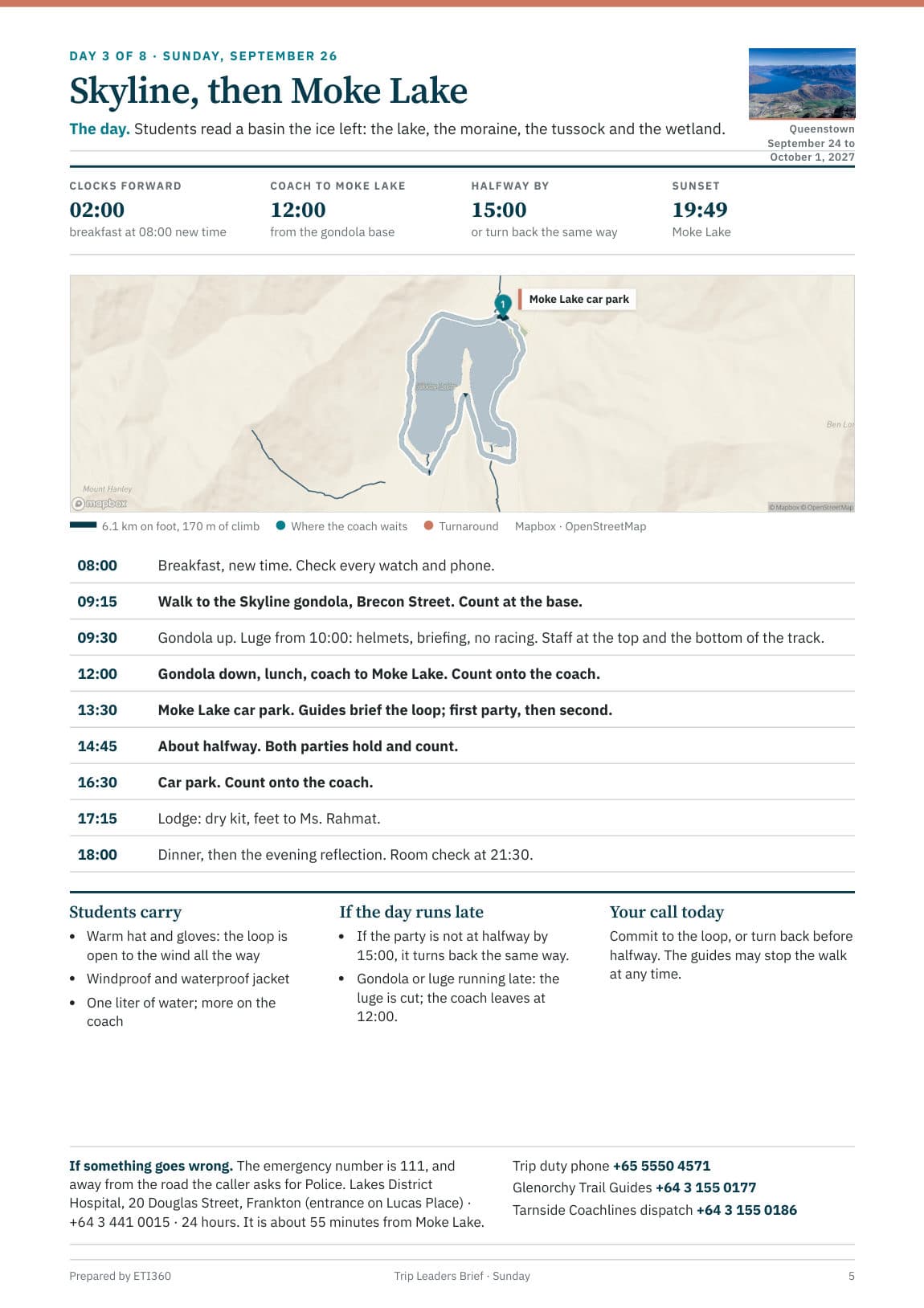
- Trip Leaders BriefTrip leadersEvery adult on the trip gets one page per day with the plan, the contacts and what to do in an emergency.
- Day mapsOutdoor daysEach outdoor day gets a pocket card with the route, the distance, the climb and the time at the group’s pace.
- Educational Travel FieldbookStudentsStudents carry the fieldbook and connect each day’s places to what they’re learning in class.
- Field Trip ReportsDay tripsA day trip to the zoo needs less than a week away, but it still needs a plan. One pack covers the year, with a page for each trip and a calendar for each month.
- Conference Travel ReportsAthletics and activitiesCoaches get one guide for the season’s away games and events, with every trip in the conference on it.
- Incident Report SystemIncident reportsNobody fills in a long form on a trip. Leaders record what happened from their phones, and it runs in your school’s own Google Workspace or Microsoft 365.
- Post Trip ReportFeedbackAfter the trip we pull together the leaders’ notes and what students and families said. Your school decides what to change next time.
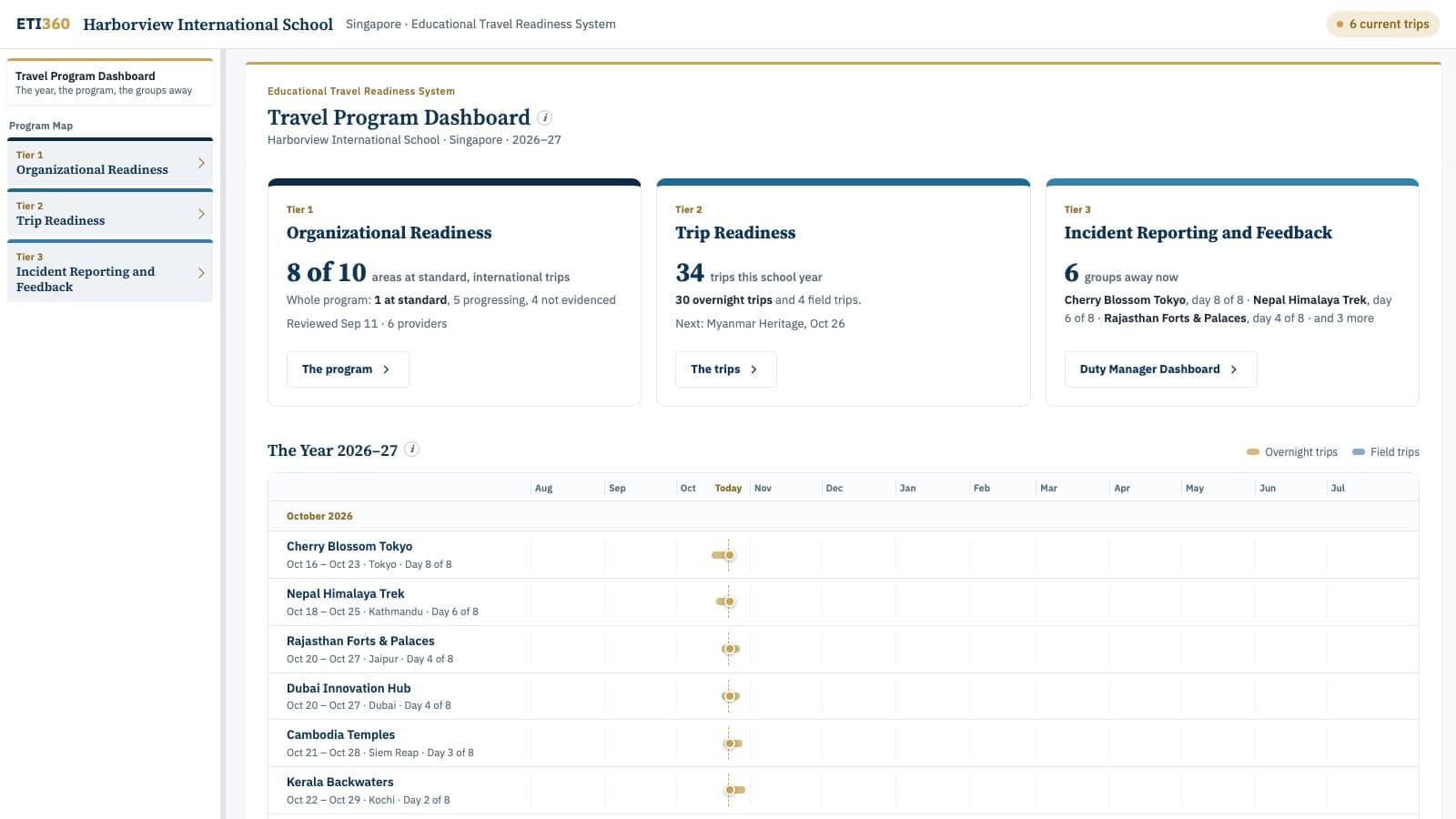
The Travel Program Dashboard
Your program review sits at the top of the page. Each trip with its reports is in one location.
When groups are away you can track the schedules and conditions.
What Your School Receives
ETI360 provides risk intelligence for school trips. We help schools strengthen their travel programs, prepare for individual trips, and support staff while groups are away.
We take the itineraries, your providers’ documents and your school’s procedures and turn them into reports your staff can use. We don’t write your risk assessments. Your school writes them, and we make sure you have everything you need to do it.
You can follow Harborview International School through a year with us, from the Travel Program Review to the report after each trip.
Why Schools Work With Us
ETI360 is easy to use. Your school sends us what you have by email. The reports and the Dashboard come back in the same format every time. There is nothing new to learn to get started.
We know educational travel from the inside. Dan Skimin ran school travel programs for 16 years, 600 programs and 12,000 students. Seb Wong is a serving school safety manager. We built the system around how a school runs its trips.
There are no forms. You email us what you have and we do the research.
We add what you do not have. You may have the hotel. We find the nearest hospital, the drive time and the weather for the week.
Your records stay yours. Incident reports live in your own Google Workspace or Microsoft 365 and we never read them.
Contact
Write to Dan Skimin at danskimin@eti360.com. We reply within two working days.